Alloy Additions and Trim Chemistry
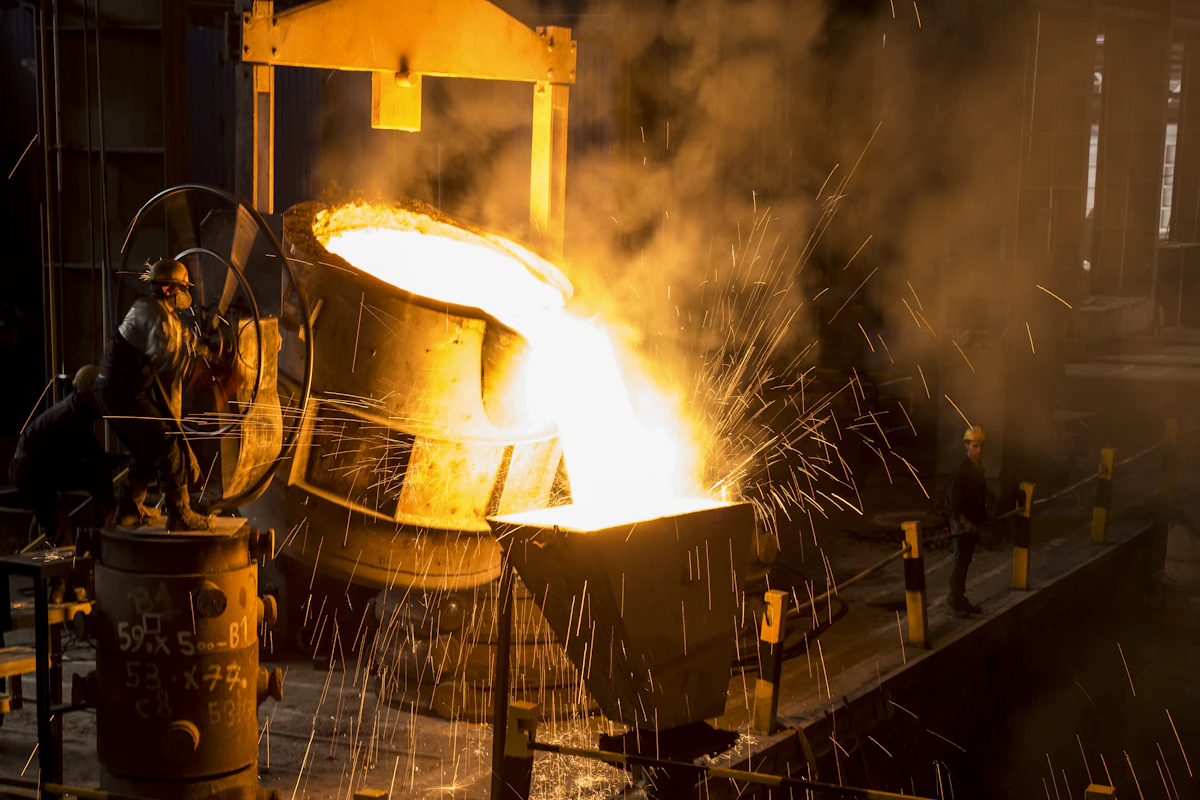
Alloying in the ladle furnace is the precision step in steel chemistry — the LF is where the final composition window is closed. Bulk additions (ferromanganese, ferrosilicon, ferrochrome) were made at BOF/EAF tapping, deliberately held 10–20% below the final target to allow for trim at the LF without the risk of overalloying. At the LF, trim additions of 5–100 kg (depending on furnace size and specification tightness) fine-tune each element to within ±0.01% of the target.
Ferroalloy dissolution is governed by the same mass transfer principles as desulphurisation: strong argon stirring ensures rapid dissolution and homogeneous distribution. Alloy additions should be completed with adequate arc-off time remaining for a "soft stir" — a period of gentle argon stirring with the arc off to float out any oxide inclusions generated by the dissolution and allow inclusion flotation into the slag before the ladle departs.
For grades requiring very tight tolerances — interstitial-free (IF) automotive steel with <30 ppm C and <30 ppm N, bearing steel with <10 ppm O — the LF prepares the steel to the point where further refinement in the RH or VD degasser is required. The LF cannot remove dissolved gases (hydrogen, nitrogen, excess oxygen) below the limits set by thermodynamic equilibrium at ladle pressure and temperature. This handoff — LF to vacuum degasser — is the defining step for ultra-clean steel grades.
When the LF Hands Off to Vacuum Degassing
After LF treatment, certain steel grades require vacuum degassing to remove dissolved gases that cannot be extracted at atmospheric pressure. The driving force for degassing is thermodynamic: at 1 millibar absolute pressure, the equilibrium dissolved hydrogen in liquid steel is less than 0.5 ppm (vs ~3 ppm at atmospheric pressure), and the equilibrium carbon-oxygen product falls dramatically, enabling ultra-low carbon decarburisation.
Grades requiring vacuum treatment: - Ultra-low carbon (IF steel): Interstitial-free steels for automotive deep drawing require <30 ppm C and <30 ppm N. The RH degasser achieves this by recirculating the steel between the ladle and the vacuum vessel at high rates — up to 150 t/min — through the up-snorkel (argon injection lifts steel up) and the down-snorkel (gravity return). The CO evolution at low pressure drives decarburisation to <10 ppm C in 15–20 minutes. - Ultra-low hydrogen (heavy plate and forging grades): Hydrogen above 2–3 ppm in solidified steel causes flaking — internal hydrogen-induced cracking in heavy sections. VD (vacuum degasser) or RH treatment to <2 ppm H₂ is mandatory for plate thicknesses above 50 mm. H₂ degassing is rapid at vacuum: 15–20 minutes suffices for most applications. - Ultra-low nitrogen (<50 ppm N for electrical steel): Nitrogen is the most difficult dissolved gas to remove because N₂ desorption kinetics are slower than CO or H₂ desorption. Achieving <50 ppm N requires a combination of EAF practice (sealed tapping, argon shrouding), careful LF slag management, and VD treatment. Full nitrogen removal to <30 ppm is rare and expensive. - Ultra-low total oxygen (<10 ppm for bearing steel): RH-OB (oxygen blowing) is used for bearing grades: oxygen is injected into the RH vessel to react with excess aluminium and carbon, generating CO evolution that flushes oxygen and inclusions upward into the slag layer. A 20–30 minute RH-OB treatment achieves <10 ppm total oxygen.
RH vs VD comparison: The RH degasser is the high-throughput workhorse — it can treat 300 t in 20–30 minutes, inject alloys and oxygen under vacuum, and integrate directly with the casting sequence. The VD (vacuum tank degasser) is simpler in concept (the ladle is placed in a sealed vessel under vacuum, with argon stirring through the bottom plugs) and is highly effective for hydrogen removal at lower capital cost. VD is preferred for heavy plate and forging shops where hydrogen removal is the primary target; RH is preferred for high-volume flat-rolled production where ultra-low carbon is required.
Key ladle furnace terms
Tap each card to reveal the definition.
Key ladle furnace operating parameters
| param | value |
|---|---|
| Ladle capacity | 80–350 t |
| Transformer rating | 20–60 MVA |
| Heating rate | 3–5 °C/min |
| Arc-on time | 10–40 min |
| Total treatment time | 20–60 min |
| Sulphur removal target | <0.005% (standard); <0.001% (ultra-low) |
| FeO in slag (target) | <1% (white slag condition) |
| Slag basicity target | CaO/SiO₂ = 3–5 |
| Argon stirring flow (arc-on) | 3–8 NL/min·t |
| Argon soft stir (arc-off) | 0.5–2 NL/min·t |
| Temperature window to caster | ±5–10 °C |
| Electrode consumption | 0.3–0.8 kg/t |
Typical parameters for a 150–300 t ladle furnace at a modern integrated or EAF steelplant.
The ladle furnace enables tight chemistry windows that the BOF and EAF cannot achieve alone
Modern steel specifications — particularly for automotive, linepipe, bearing, and electrical grades — require composition tolerances of ±0.01–0.02% on multiple elements simultaneously, with sulphur <0.005% and dissolved oxygen <20 ppm. Neither the BOF nor the EAF can achieve these windows in the primary vessel: the intense reactions and high temperatures are incompatible with the precision required. The LF, operating at 1,580–1,620 °C with controlled stirring and reducing slag, is the only practical environment for closing these windows before casting.
End-of-Module Quiz
Sign up to take the quiz
Create a free account to take the Ladle Furnace (LF) — Secondary Metallurgy quiz — pass to claim a verifiable certificate you can add to LinkedIn.