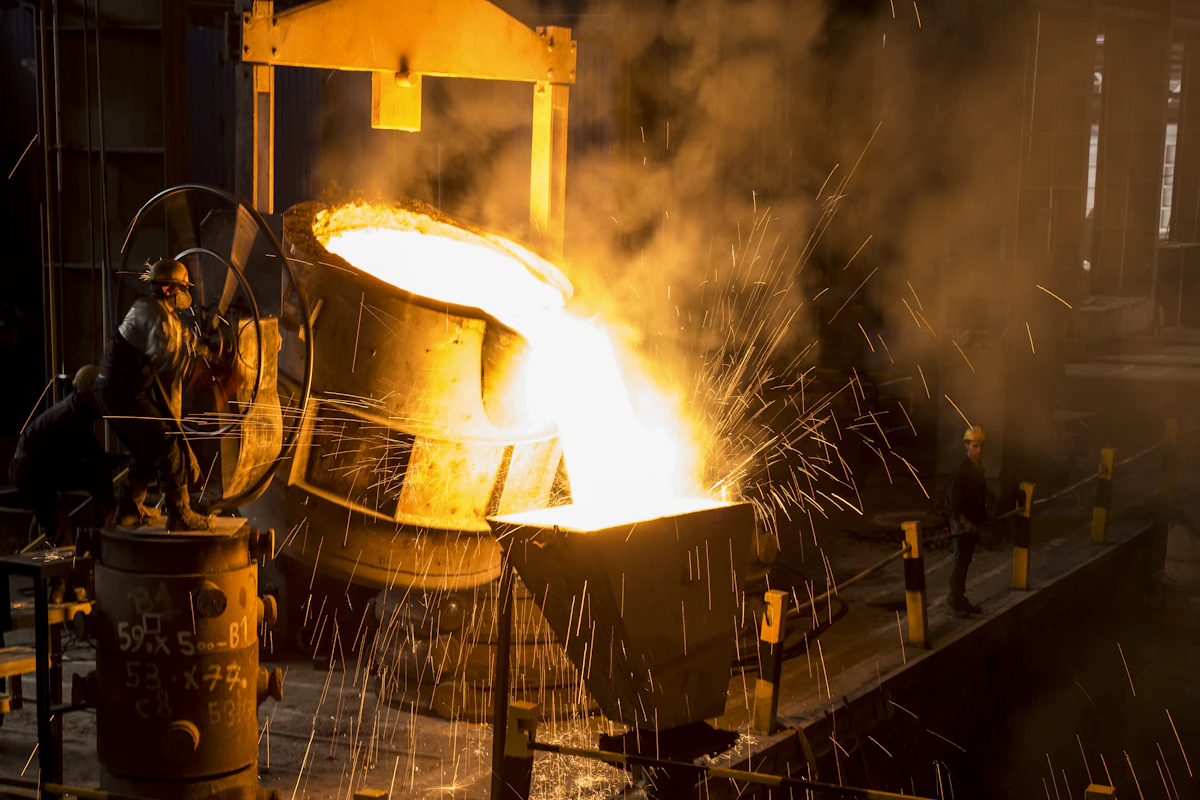
Process Overview
The ladle furnace (LF) is the workhorse of secondary metallurgy — the stage of steelmaking that occurs between the primary furnace (BOF or EAF) and the continuous caster. Its function is to refine the crude steel received from the primary furnace to the precise temperature, composition, and inclusion cleanliness demanded by the downstream caster and the final product specification.
A ladle furnace consists of a conventional steel ladle (80–350 t capacity) positioned on a treatment station equipped with a retractable graphite electrode roof (typically three-phase AC, 20–60 MVA transformer rating), argon purge plugs in the ladle bottom, and a flux and alloy addition system. The ladle sits on a car that shuttles between the primary furnace tapping station, the LF station, any vacuum degassing station, and the caster.
The LF was developed in the 1970s — the first commercial installation was at Asea in Sweden in 1971 — in response to the limitations of in-furnace refining: the BOF and EAF are optimised for melting and bulk chemistry adjustment, not for the precise temperature and composition control and inclusion modification that clean steel production requires. Separating secondary metallurgy into the ladle furnace gives each unit operation its optimal environment and removes the time pressure from the primary furnace, increasing tap-to-tap productivity.
Electrical Heating and Arc Practice
LF heating raises the steel temperature at approximately 3–5 °C/min using graphite electrodes of 250–450 mm diameter operating at lower power than an EAF (typically 20–60 MVA versus 80–250 MVA). The lower power density reflects the different task: the LF is heating a fully liquid steel bath with no scrap melting — gentle, controlled heating is preferable to the intense energy injection of the EAF.
Arc length is set to operate in the "buried arc" condition — submerged in the covering ladle slag. This protects the arc from nitrogen pickup from the air above the slag, prevents reoxidation of the steel by atmospheric oxygen, and transfers heat efficiently to the bath through the slag layer. The ladle slag also insulates the steel against temperature loss to the ladle shell and roof.
The LF heating rate determines the available time for chemistry adjustment and inclusion flotation before the caster's sequencing window requires the ladle to depart. Typical LF treatment time is 20–60 minutes, depending on the required temperature correction, chemistry trim requirements, and whether the heat proceeds to vacuum degassing (which adds 20–45 minutes of treatment before the caster). Managing the "tapping temperature window" — knowing how hot to tap the BOF/EAF to minimise LF arc time while maintaining flexibility — is one of the most important operational optimisation problems in the steelmaking sequence.
The Tapping Window and Sequence Planning
The LF's most critical scheduling function is managing the temperature deficit inherited from the BOF or EAF. The primary furnace deliberately taps the ladle 20–50 °C below the caster optimum temperature, relying on the LF to make up the difference through arc heating. This strategy decouples the primary furnace's tap-to-tap time from the caster's sequencing constraints — the BOF can tap as soon as the heat is ready, without waiting for the caster to be ready to receive a ladle at exact casting temperature.
The "heat sequencing" problem is the operational challenge this creates: a melt shop may have three to five ladles simultaneously in transit between the BOF, the LF, the vacuum degasser, and the caster. Each ladle is at a different temperature, at a different stage of treatment, and losing heat at different rates depending on ladle age and preheat condition. The LF operator must predict the arrival temperature of each ladle at the caster to within ±5 °C — a window that is rarely forgiving.
The key variables governing temperature trajectory are: - Ladle preheat condition: A cold ladle (ladle just back from reline, under 800 °C lining temperature) absorbs 40–60 °C more heat from the steel than a hot ladle (lining at 1,100–1,200 °C from the previous heat). Cold ladle use is planned and the LF arc time is extended accordingly. - LF treatment duration: Each minute of arc-on heating adds 3–5 °C; each minute of argon-only stirring loses 2–4 °C depending on ladle cover effectiveness. - Alloy addition chill: Large ferroalloy additions (ferromanganese, FeSi) at cold temperatures absorb 1–3 °C per 10 kg/t of alloy added. - Transfer time to caster: Each minute of transit loses approximately 1–2 °C depending on ladle cover insulation quality.
Modern integrated plants use real-time ladle tracking systems with temperature prediction models to manage these variables, routing ladles across the melt shop and scheduling LF arc time to deliver each ladle to the caster within the ±5 °C window.
Pause and think
The LF heats steel using a graphite arc, but the arc current is not passed through the steel — it passes through the slag layer above it. What does this mean for the chemistry of the slag, and why is it critical to establish the right slag before the arc is switched on?
Temperature evolution during LF treatment
Schematic based on LF process literature (Ironmaking & Steelmaking; ABB/SMS LF technical publications). Arc-on heating phases (rising) and arc-off argon stirring phases (falling) are visible in the profile.
Steel temperature pickup during arc heating, temperature loss during argon stirring (no arc), and the superimposed effect of alloy and flux additions on heat balance. The LF must deliver the steel to the caster within a tight 10–15 °C temperature window.