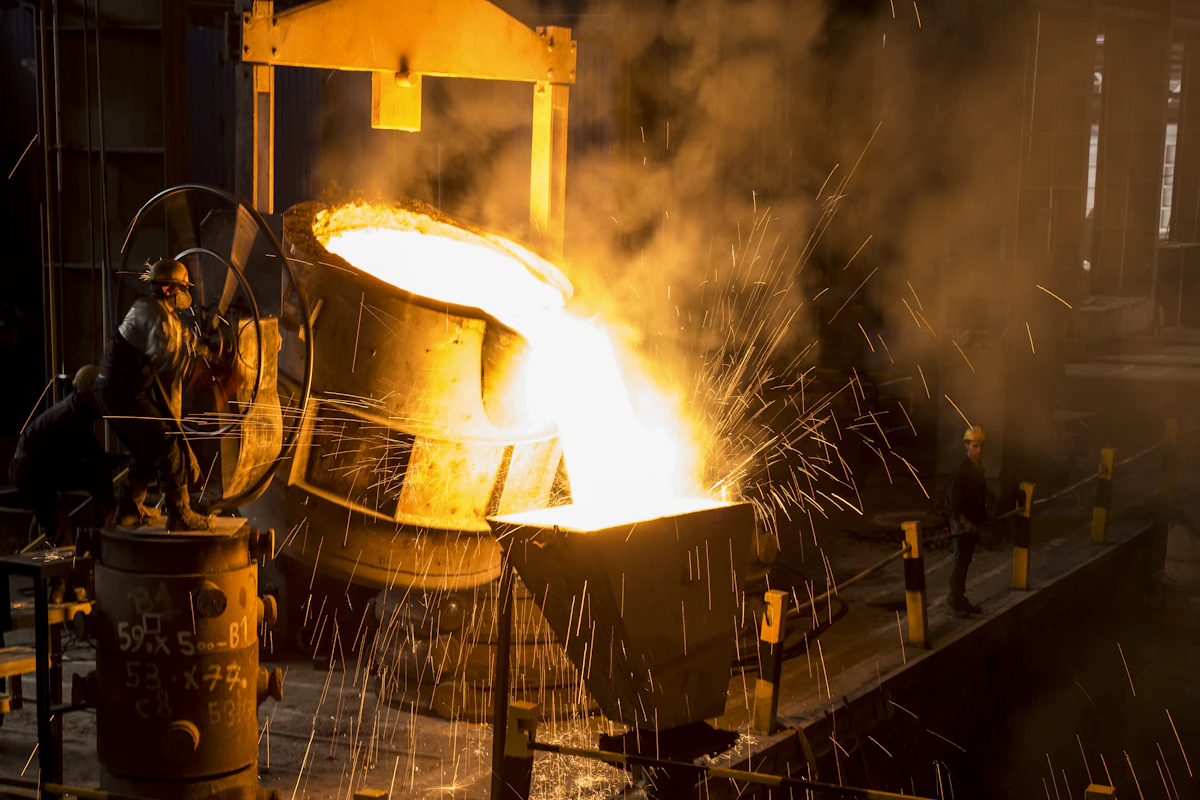
Desulphurisation Kinetics
Sulphur removal in the ladle furnace is the most kinetically constrained refining operation in secondary metallurgy. The thermodynamics strongly favour sulphur partition into a basic, reducing, fluid slag: the sulphide capacity of slags with CaO/SiO₂ of 3–5 is 100–1,000 times higher than that of neutral slags. In practice, LF desulphurisation can reduce sulphur from 0.015–0.030% (as tapped from the BOF) to <0.005% for standard grades and <0.001% for demanding applications (linepipe, bearing steel, tire cord).
The rate of desulphurisation is controlled by mass transfer of sulphur across the steel-slag interface, not by thermodynamic equilibrium. This interface is maximised by strong argon stirring from the ladle bottom purgeplugs, which generates turbulent mixing and continuously replenishes the steel-slag interface with sulphur-bearing steel and with fresh slag surface. Stirring intensity is the key kinetic lever: too little stirring and the reaction rate is slow; too much and the slag is emulsified into the steel, forming fine oxide inclusions rather than floating cleanly.
Desulphurisation is also enhanced by wire injection — calcium silicide (CaSi) or calcium aluminium (CaAl) wire fed at 80–150 m/min through a hollow lance into the steel bath, decomposing to release calcium that combines directly with sulphur to form CaS inclusions. Calcium injection also modifies solid Al₂O₃ inclusions (formed during aluminium deoxidation) into liquid calcium aluminates, preventing clogging of the submerged entry nozzle (SEN) at the continuous caster.
Synthetic Slag and Slag Chemistry
The ladle slag at the LF start — inherited from BOF/EAF tapping additions — is typically oxidising (high FeO, 10–25%) and insufficiently basic for effective desulphurisation or inclusion absorption. The first step in LF treatment is slag reduction and chemistry adjustment: additions of aluminium (or CaSi wire) reduce FeO in the slag to <1%, and lime additions raise basicity (CaO/SiO₂) to the target of 3–5.
A synthetic slag, pre-mixed from lime, fluorspar (or alumina), and pre-reduced flux components, can be added to the ladle at tapping to immediately provide the correct LF slag chemistry without relying on in-situ reduction. Pre-melted flux additions (calcium aluminate, calcined lime) dissolve faster than raw limestone and enable faster achievement of the reducing slag condition.
The target "white slag" — visually white or pale yellow, indicating very low FeO (<0.5%) and high sulphide capacity — is the operational proxy for a fully reduced, highly basic LF slag. A skilled meltshop operator can assess slag quality from colour: grey or green tinges indicate FeO or MnO contamination; white indicates a well-reduced slag ready for deep desulphurisation. Modern plants use optical basicity models and slag sampling to quantify conditions, but the visual assessment remains a valuable on-the-floor indicator.
Pause and think
Calcium wire is injected into the steel to modify Al₂O₃ inclusions into calcium aluminates. Why does Al₂O₃ need to be modified — what goes wrong at the caster if it is not?
Inclusion Control and Clean Steel
Inclusion cleanliness — the total population, size distribution, and chemistry of non-metallic inclusions in the solidified steel — is the ultimate output quality metric of the LF and secondary metallurgy station. Inclusions degrade fatigue life, toughness, and surface quality; for demanding applications (bearings, springs, automotive skin panel, tire cord wire) inclusion control is the defining process challenge.
The main inclusion types and their origins: - Al₂O₃ clusters from aluminium deoxidation: large, hard, and most damaging. Modified by calcium treatment to liquid calcium aluminates. - MnS from solidification: elongated stringers that form at grain boundaries during slow cooling. Reduced by low sulphur (<0.005%) and controlled by calcium treatment (which converts MnS to spherical CaS). - Calcium aluminates after Ca treatment: liquid at casting temperature, spherical, and much less damaging than Al₂O₃ — the target inclusion type. - TiN in titanium-alloyed grades: hard, angular precipitates forming at high temperature — managed by tight nitrogen control (<50 ppm N) and careful Ti addition.
The flotation mechanism governs how quickly inclusions rise to the slag: Stokes' law gives rise velocity proportional to the square of inclusion diameter. A 50 µm Al₂O₃ cluster rises 20–30 times faster than a 10 µm cluster in the same stirred bath. This is why the soft stir period — the final 5–10 minutes of LF treatment with the arc off and gentle argon stirring at 0.5–2 NL/min·t — is critical: it gives inclusions time to grow by Ostwald ripening and collision, and to float to the slag layer before the ladle departs for the caster. Premature departure (insufficient soft stir time) is a common cause of inclusion-related surface defects in automotive and packaging grades.
Industry measures steel cleanliness as total oxygen — the sum of dissolved oxygen and oxygen bound in inclusions — measured by vacuum fusion extraction on a solid steel sample. Target total oxygen is <20 ppm for standard clean steel grades, <10 ppm for bearing steel, and <5 ppm for the most demanding aerospace and bearing grades. Each step from deoxidation through LF treatment through soft stir to caster superheat management contributes to total oxygen reduction.